

Upgrading the “Human OS”: The Secret Behind Successful AI Implementation
In our last installment, we followed Javier (CEO) and Elena (CTO) as they defined their Strategic North Star. The “AI Fog” in the boardroom had lifted, and they finally had a roadmap with clear horizons: Now (3-6 months), Next (6-12 months), and Beyond (1-3 years). However, as they prepared to execute, they hit a different kind of wall.
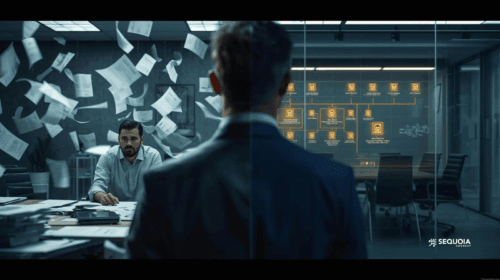
The roadmap was perfect on paper, but the people were paralyzed.
Elena’s engineering team was trapped in “Replacement Anxiety,” fearing that their deep technical wisdom was being reduced to a prompt. Meanwhile, Javier’s functional managers—heads of HR, Finance, and Marketing—were treating AI as “Elena’s project.” They were waiting for IT to deliver a finished tool rather than owning the transformation of their own departments.
The realization was clear: this wasn’t a software problem; it was a Human OS (Human Operating System) problem. This is where the journey of Phase 2: Upgrading the ‘Human OS’ through Radical Ownership begins.
The Management Mandate: From User to Orchestrator
The biggest bottleneck for AI isn’t processing power; it’s an outdated mental model of how work gets done. Most managers treat AI as a better “search engine” or a “template generator.” True transformation requires moving beyond this passive “user” mindset.
In Phase 2, the organizational shift moves toward Orchestration. The value of a manager is no longer found in the execution of tasks, but in the Mastery of Intent. Whether leading a dev team or a finance department, the new role is to provide the Architectural Intent that guides the machine to a meaningful outcome.
Radical Ownership for Functional Leaders
This evolution is not reserved for the engineering floor. The 80% failure rate often cited in AI projects usually stems from functional leaders who disengage from the technical process. To fix this, Radical Ownership must be implemented across the entire leadership board.
While this transition facilitates a broad spectrum of behavioral and cognitive competencies, three primary pillars anchor the transformation:
- Mastery in Intent Communication: Teams must stop giving technical instructions and start communicating business objectives to the machines.
- Architectural Judgment: AI can generate code or content, but the human must validate its integrity, security, and scalability. This is where the true value of the veteran and the subject matter expert resides.
- Resilience and Negotiation: In a VUCA environment, the leaders driving the change must know how to negotiate requirements and adapt with unprecedented speed.
The Functional Orchestrator: Beyond the Keyboard
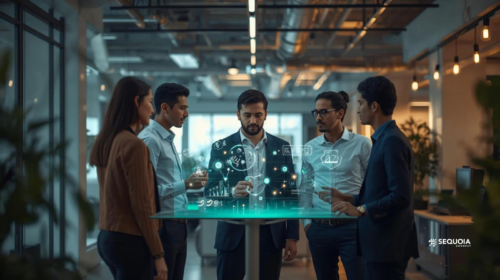
For non-technical managers in HR, Finance, and Operations, Phase 2 is about moving from being passive “users” of software to becoming active “orchestrators” of outcomes.
- For the HR Director: AI isn’t just about automated screening; it’s about orchestrating a new talent architecture.
- For the Finance Head: AI isn’t just a reporting tool; it’s about leading the machine to simulate risk scenarios in real-time.
- For Marketing: It’s about moving from “approver” to “architect of the brand’s voice.”
Identifying the Champions: Leading the Charge
The execution of the roadmap depends on identifying the Champions—both technical and functional. These are the leaders with the resilience and business acumen to guide AI-augmented Agile Squads. These Champions are the ones who turn the NOW (3-6 months) horizon into a reality, proving that AI delivers industrial ROI today.
The Result: From Friction to Orchestration
For Javier and Elena, the partnership with Sequoia Connect provided the framework to bridge this gap, turning a technical investment into measurable industrial results. By upgrading the “Human OS,” the fear of replacement dissolved into a culture of co-creation.
As Elena puts it: “We are no longer a company that uses AI; we are an organization of orchestrators who lead with intent.”
The team is empowered, but how do we ensure this agility doesn’t depend on a single tool? In our next installment, we explore Phase 3: Building Tool-Agnostic Foundations.
Is your team’s “Operating System” ready for AI, or are you still trying to run the future on legacy hardware?
3. Guiding the Way: Community Advice and Questions
The landscape of Enterprise AI is shifting by the minute, and navigating this transition requires more than just code—it requires shared wisdom. We want to hear from you:
💬 How are you managing “replacement anxiety” within your senior technical and functional teams?
💬 Which human competencies do you believe are impossible to automate in your specific industry?
💬 When identifying your “Champions,” do you prioritize technical skill or leadership and adaptability across different business areas?
Ready to accelerate your career?
- Looking for a new job? Check out our Careers Page.
- Struggling to land a role? Explore our Mentoring & IT Outplacement Services.
- Need high-value tech candidates? Visit our IT Headhunting Services.
- Are you a talent professional looking to implement AI? Get to Know our AI Training Programs for HR.
- Are you a technology leader ready to bridge the evolution gap? Discover the ATLAS Enterprise AI Transformation & Strategy.
Sources & References
- GMIT Sloan Management Review: The human factor is responsible for 84% of failures in AI projects.
- RAND Corporation: The lack of talent architecture is the leading cause of death for AI pilots.
- Sequoia Connect: Methodology for Human OS Upgrades and Radical Ownership.
- Harvard Business Review: The evolution of technical roles toward strategic orchestration.
- [Master] Why Your AI Strategy is Just Technical Noise: https://sequoia-connect.com/why-your-ai-strategy-is-just-technical-noise/
- [Phase 1] Strategic AI: Building the Year’s Roadmap: https://sequoia-connect.com/strategic-ai-building-the-years-roadmap/